Saturday, July 19, 2008

Wheat among the Weeds

The more popular title of this parable from Matthew 13:24-43 is "Weeds among the Wheat." I wonder whether it is possible to call it instead, "Parable of the Wheat among the Weeds." The former title seem to presuppose that there are more wheat than weeds. Well, because as the parable says, it was what the owner of the vineyard planted.

If we are to grant the explanation that the wheat are the "good" people, and the weeds are the "bad" people whom God has allowed to exist alongside the good people, aren't there times when it seems that there are more bad people than good people. And amidst the growing numbers of bad people, it seems more and more difficult to be good. It's difficult to be a wheat among the weeds, especially if the weeds grow faster than the wheat.

With this feeling, we find the St Paul's very consoling:
"The Spirit comes to the aid of our weakness;
for we do not know how to pray as we ought,
but the Spirit himself intercedes with inexpressible groanings.
And the one who searches hearts
knows what is the intention of the Spirit,
because he intercedes for the holy ones
according to God’s will."

Take courage, then, wheat of God.

Saturday, July 12, 2008

Seeds of Prayer and Silence

Sunday, July 13, I am giving a day of recollection to some nuns of the Religious Sisters of Mercy in Camp Philips, Bukidnon. I surfed the internet to get an idea who they are. I found out who their foundress was, Catherine McAuley. And she has some beautiful words worth pondering on. I decided to offer these quotations as recollection points for the sisters. Like the Sunday Gospel, Catherine makes use of the image of planting.

Prayer is a plant the seed of which is sown in the heart of every Christian, but its growth entirely depends on the care we take to nourish it.

Retreat Instructions, p. 90

Thus we go on…flourishing in the very midst of the Cross, more than a common share of which has latterly fallen to my lot, thanks be to God. I humbly trust it is the cross of Christ. I endeavor to make it in some way like his by silence.

Letter to Frances Warde May 15, 1838

Happy Sunday!

Saturday, July 05, 2008

Isn't It Heavy?

Don't we sometimes want to ask the Lord, "You said your yoke is easy, and your burden light. But actually, what you are asking me to do, the tasks you are giving me, the challenges you are asking me to face, the cross you are asking me to bear are not at easy or light! Under the weight of all these, I fall to the ground, I hurt my knees, I see sweat and blood on my skin. What made you say it is easy and light?"

But to ask this question is to miss to hear what the Lord says before these words. He says: "Come to me all who labor and are heavily burdened. Learn from me for I am meek and humble of heart. Your souls will find rest." Only if we come close to the Lord and learn from Him will our yokes and burden be easier and lighter. And there close to Him, we shall find His hand extended to us in assistance, His shoulder offered to us to lay our heads, His heart open in welcome and acceptance.

May this experience of the Lord's assuring presence inspire to say in response: I will praise your name for ever, my king and my God.

Thursday, July 03, 2008

Doubters' day

Many Catholics ask whether doubting the existence or the presence of God is a sin. Today's feast of St. Thomas, popularly known as the "Doubting Thomas" should answer that question. In the encounter between the Risen Christ and Thomas, our Lord granted Thomas' request: that he probe the nailprints and put his hands on our Lord's side. Jesus welcomed the doubts of Thomas and helped him through it and invited him to faith. Thomas' doubts, then, became a stepping stone to faith. And we are told that his profession of faith in Jesus as Lord and God the sums up all the other all previous professions of faith of the other characters in John's Gospel.

We are, then, in good company! Happy feastday, doubters!

Saturday, June 28, 2008

What Makes a Pillar

Saints Peter and Paul are called the pillars of the Catholic Church. Peter is the "rock upon which the Church is built" (Mt 16:18) and Paul is the "chosen vessel through whom the Gospel is proclaimed to all nations" (Acts 9:15).

We usually think of a pillar as a rock, strong, sturdy, heavy. Are these the reasons why Peter and Paul are called pillars of our faith? Because they are strong, sturdy?

On the surface, it seems they were strong, but we know that their weaknesses got the better of them too. Their being "pillars of the Church" must be for some other reason.

In the post-resurrection encounter between Jesus and Peter, Jesus asks him: “Simon, son of John, do you love me more than these?” And Peter confesses his love for Christ, knowing fully well how he failed the Lord.

Paul, for his part, declares: “Though I myself have reason for confidence in the flesh also. If any other man thinks he has reason for confidence in the flesh, I have more:
But whatever gain I had, I counted as loss for the sake of Christ. Indeed I count everything as loss because of the surpassing worth of knowing Christ Jesus my Lord. For his sake I have suffered the loss of all things, and count them as refuse, in order that I may gain Christ”
(Phil 3:4, 7-8)

Hence, it is their love, their love for Christ that made them pillars of our Church; their strength comes from their love for Christ.

What's the source of your strength?

We pray that like Peter and Paul, we may find in Christ our pillar of strength.

Saturday, June 07, 2008

As Certain as the Dawn

The first reading this Sunday answers the question: Why is our Hope In Him Alone?

“Let us know, let us strive to know the LORD; as certain as the dawn is his coming, and his judgment shines forth like the light of day! He will come to us like the rain, like spring rain that waters the earth.”

In Him alone is our hope because only in God can we find certainty, security. Human hopes, human loves, as we know and have experienced it are ultimately fragile, conditional, transitory. This the prophet Hosea also illustrates by saying:

What can I do with you, Ephraim?
What can I do with you, Judah? Your piety is like a morning cloud,
like the dew that early passes away.

Let us, on this Sunday, reaffirm our hope and trust in the Lord as we sing:

In Him alone is our hope. In Him alone is our strength. In Him alone are we justified. In Him alone are we saved. [refrain of the song "In Him Alone" by MVFrancisco, in the album "The best of Bukaspalad vol. 2]

Saturday, May 10, 2008

Through the Fire

A few beautiful lines from Pope Benedict's Spe Salvi, in connection with Pentecost, the coming down of the Holy Spirit upon the apostles and Mary as tongues of fire:

47. Some recent theologians are of the opinion that the fire which both burns and saves is Christ himself, the Judge and Saviour. The encounter with him is the decisive act of judgement. Before his gaze all falsehood melts away. This encounter with him, as it burns us, transforms and frees us, allowing us to become truly ourselves. All that we build during our lives can prove to be mere straw, pure bluster, and it collapses. Yet in the pain of this encounter, when the impurity and sickness of our lives become evident to us, there lies salvation. His gaze, the touch of his heart heals us through an undeniably painful transformation “as through fire”. But it is a blessed pain, in which the holy power of his love sears through us like a flame, enabling us to become totally ourselves and thus totally of God.

Let the psalm response in the Mass for Pentecost be our prayer too:

Lord, send forth your spirit, and renew the face of the earth!


(pix from http://home.indy.rr.com/legionofmary/images/HolySpirit2.jpg)

Saturday, May 03, 2008

Langit sa Piling Mo

Langit ang buhay
sa tuwing ika'y hahagkan.
Anong ligaya sa tuwing mamasdan,
sa piling mo, ang gabi'y tila araw.
Ikaw ang pangarap, ikaw lamang.

what shall we say about heaven? What is heaven?
If we want a theological treatise on it,
we can consult various theologians and scholars. Can we maybe
summarize their point by saying that heaven is none other than

being with Christ (sa piling mo...)
, with Him is profound joy, (anong ligaya sa tuwing ika'y mamasdan)
for He is all we desire, (ikaw ang pangarap, ikaw lamang)
and with Him, nights are as days. (ang gabi'y tila araw)

May we experience the Risen Lord, the Unconquerable Sun,
transforming our nights into days, thereby allowing us to experience
heaven even while here on earth.

Saturday, April 26, 2008

Orphans No More

The Gospel for the 6th Sunday of Easter reminded me of this verse from the song "So the Love of God".

Once we were lost
orphans of night
left but to wander
longing for the light
found by a love
that would not let us go
we are God's children
family forever.

Jesus promises His disciples that He will not leave them orphans.
The Holy Spirit will be their defender (the traditional task of the father of the family) and their teacher (the traditional task of the mother in the family).

At times when we feel orphaned, left alone, literally or figuratively by our biological or surrogate parents, or by those who are supposed to be our defenders and teachers, we can draw strength from the words of Jesus in today's Gospel, and of these lines from this song: "we are God's children, family forever."


pix from: imagecache2.allposters.com/images/pic/AGF/933...

Saturday, April 19, 2008

A Place For Us


SOMEWHERE

There's a place for us,
Somewhere a place for us.
Peace and quiet and open air
Wait for us
Somewhere.

There's a time for us,
Some day a time for us,
Time together with time spare,
Time to learn, time to care,
Some day!

Somewhere.
We'll find a new way of living,
We'll find a way of forgiving
Somewhere . . .

There's a place for us,
A time and place for us.
Hold my hand and we're halfway there.
Hold my hand and I'll take you there
Somehow,
Some day,
Somewhere!

music by Leonard Bernstein; lyrics by Stephen Sondheim


This song just came to my mind as I was reading the Gospel for this Sunday,
the fifth of Easter: Taking the office of consoler, as Ignatius says of the Risen Lord in the 4th week of the Spiritual Exercises, Jesus assures us of a place, not just somewhere or anywhere, but in the house of his Father, who is our Father, too.

May these words of Jesus truly console us, that even if we find no place in this world, or in the hearts of the people of this world, even in those we love, there is always a place for us, especially made and prepared for us, in the house of the Father, in the Heart of Jesus, the Good Shepherd, our only Hope.


Saturday, April 12, 2008

Shepherd of Hope

The theme of this Sunday's Gospel (Good Shepherd) continues last Sunday's theme (Walk to Emmaus). Picking up again from Pope Benedict's Spe Salvi, we get to know more deeply the source of our hope, Jesus, our Good Shepherd. And understand why He is our only hope:

“The Lord is my shepherd: I shall not want ... Even though I walk through the valley of the shadow of death, I fear no evil, because you are with me ...” (Ps 23 [22]:1, 4). The true shepherd is one who knows even the path that passes through the valley of death; one who walks with me even on the path of final solitude, where no one can accompany me, guiding me through: he himself has walked this path, he has descended into the kingdom of death, he has conquered death, and he has returned to accompany us now and to give us the certainty that, together with him, we can find a way through. The realization that there is One who even in death accompanies me, and with his “rod and his staff comforts me”, so that “I fear no evil” (cf. Ps 23 [22]:4)—this was the new “hope” that arose over the life of believers (SS 6).

What comfort and consolation indeed it is for us to realize that the roads we are afraid to tread, the mountains we are scared to climb and the rivers we are reluctant to cross, to all these Jesus Christ our Shepherd had been, and has come back to accompany us as we walk these roads, as we climb these mountains, as we cross these rivers...

"...and to assure us that together with Him, we shall find our way through."

*pix from Von größter Schönheit

Saturday, April 05, 2008

"But We Were Hoping..."

"But we were hoping that He would be the one to redeem Israel" (Lk 24:21).

The walk to Emmaus is really a walk of Hope. Two men who had hoped, who seemed to have given up hope, walk away from Jerusalem, the place where their hope had been crushed. Then suddenly, the risen Jesus walks with them to rekindle the flame of hope in their hearts. It is the accompanying presence of Jesus that awakens their hope. Because Christ is with them, they have hope. Pope Benedict makes this point in Spe Salvi, his encyclical on Christian Hope. He quotes from a letter of Paul Le-bhao-tin, a Vietnamese martyr who was imprisoned for the faith:

In the midst of these torments, which usually terrify others, I am, by the grace of God, full of joy and gladness, because I am not alone —Christ is with me ... (SS 37)

May we perceive Christ present in our journeys awakening the flame of hope in our hearts.

graphics from: www.jsmatt.com/custom4.html

Saturday, March 29, 2008

The Rays of Divine Mercy

The image of Jesus King of the Divine Mercy shows our Lord pointing to His Heart where rays of light shine forth. Pope Benedict, in Spe Salvi, his encyclical on Christian hope speaks of the transformative power of this rays of light or fire of love:

Some recent theologians are of the opinion that the fire which both burns and saves is Christ himself, the Judge and Saviour. The encounter with him is the decisive act of judgement. Before his gaze all falsehood melts away. This encounter with him, as it burns us, transforms and frees us, allowing us to become truly ourselves. All that we build during our lives can prove to be mere straw, pure bluster, and it collapses. Yet in the pain of this encounter, when the impurity and sickness of our lives become evident to us, there lies salvation. His gaze, the touch of his heart heals us through an undeniably painful transformation “as through fire”. But it is a blessed pain, in which the holy power of his love sears through us like a flame, enabling us to become totally ourselves and thus totally of God (SS no. 47).

May the flame of love and mercy from the heart of Jesus, King of Mercy truly transform us as it did St Thomas, from a doubter to a believer.

Painting by Bernardo Strozzi; Oil on canvas, 89 x 98.2 cm

Friday, March 21, 2008

He Descended Into Hell

On Black Saturday, when we recall the day Christ was in the tomb, we also reflect on the phrase in the Creed, "He descended into the dead." Pope Benedict offers the following reflections from his latest encyclical Spe Salvi:

Christ descended into “Hell” and is therefore close to those cast into it, transforming their darkness into light. Suffering and torment is still terrible and well- nigh unbearable. Yet the star of hope has risen—the anchor of the heart reaches the very throne of God. Instead of evil being unleashed within man, the light shines victorious: suffering—without ceasing to be suffering—becomes, despite everything, a hymn of praise (SS 37).

Pope Benedict spoke of these points when he talked about suffering as setting for learning hope. To illustrate what hell is like, he used the experience of Vietnamese martyr, Paul Le Bao-Tinh, who amidst all the violence and cruelties of the prison, was able to find hope... precisely in his faith in Jesus Christ.

May, we, too, experience Jesus descending into the "hells of our lives" and transforming our darkness into the light of Easter!

Wednesday, March 19, 2008

Praying these Holy Days

These next three days, the Paschal Triduum, when we remember the great events of our faith, the mysteries of our faith, the passion, death and resurrection of the Lord, we are asked to pray more intensely. Hence we see many Christians, as individuals or in groups, flocking to Catholic Churches to spend time in quiet prayer before the Lord, especially during the Visita Iglesia or Vigil before the Blessed Sacrament Holy Thursday night.

Pope Benedict says something beautiful and worth noting when we pray these next three days and all throughout our life:

"To pray is not to step outside history and withdraw to our own private corner of happiness. When we pray properly we undergo a process of inner purification which opens us up to God and thus to our fellow human beings as well.

We must learn that we cannot pray against others. We must learn that we cannot ask for the superficial and comfortable things that we desire at this moment—that meagre, misplaced hope that leads us away from God. We must learn to purify our desires and our hopes (Spe Salvi 33).

Indeed, may we truly be purified by our prayers these days and be mindful of the needs of others and lift them up to God together with our own.

Saturday, March 08, 2008

Eternal Life... What is It?

What kind of life is Jesus offering when he says, "“I am the resurrection and the life; whoever believes in me, even if he dies, will live, and everyone who lives and believes in me will never die”?

Pope Benedict helps us reflect on this question with these excerpts from his latest encyclical Spe Salvi:

Obviously there is a contradiction in our attitude, which points to an inner contradiction in our very existence. On the one hand, we do not want to die; above all, those who love us do not want us to die. Yet on the other hand, neither do we want to continue living indefinitely… To continue living for ever —endlessly—appears more like a curse than a gift. Death, admittedly, one would wish to postpone for as long as possible. But to live always, without end—this, all things considered, can only be monotonous and ultimately unbearable (SS 11).

To imagine ourselves outside the temporality that imprisons us and in some way to sense that eternity is not an unending succession of days in the calendar, but something more like the supreme moment of satisfaction, in which totality embraces us and we embrace totality—this we can only attempt. It would be like plunging into the ocean of infinite love, a moment in which time—the before and after—no longer exists. We can only attempt to grasp the idea that such a moment is life in the full sense, a plunging ever anew into the vastness of being, in which we are simply overwhelmed with joy (SS 12).

Each of us has a desire waiting to be fulfilled, a wish waiting to come true, ultimately it is the desire for this eternal life being offered by Jesus Christ. But oftentimes, these are buried deep in our hearts, under our earthly, carnal and fleeting desires which we often mistake to be the lasting and truest desires. Like Lazarus in the grave, this desire for eternal life, for that supreme moment of satisfaction in which totality embraces us and we embrace totality…is waiting to be called by Jesus,. O

n this last week of Lent, as we come closer to Holy Week, let us allow Jesus to visit our graves, and call to life our deepest and truest desires by breathing the Spirit of life into our hearts, for He is our only hope and by this hope in Him, we are saved. Spe Salvi factus sumus.

Monday, February 25, 2008

From our Own Little Corner


Being geographically distant from Manila, it is a real temptation for those of us in
Mindanao not to be bothered by the turn of events in the capital city of the country, and dismiss the mass actions as mere political noise of disgruntled
citizens. But it can not be the case if one takes seriously the Filipino saying
'ang sakit ng kalingkingan ay sakit ng buong katawan' (the ailment of the pinky
finger is the ailment of the entire body) and the Pauline treatise on the Body of Christ, one can not simply remain indifferent to the socio-political situation of the
country, especially when it involves the blatant suppression of truth and shameless
greed and corruption in government.

Hence, it was a consoling and encouraging experience to see Catholics, and perhaps non-catholics also gathering at the Gaston Park, in front of the CDO Cathedral attending the Mass for Truth and the brief program that followed. I hope that this will not be the last of such activities, but simply the beginning of a series of
activities that will involve not just Catholics, but all people of good will and not just during elections, but all throughout the year, monitoring the public officials and demanding from them accountability, honesty and integrity while they are in office.

From our little corner of the archipelago, let the light of truth shine!

Saturday, February 16, 2008

What makes you shine?

The transfiguration story presents Jesus' face and clothes shining and dazzlingly white. We are told that this episode is a preview of his resurrection which will occur after his passion and death. So what brought about the Resurrection which raised Jesus to an entirely new life and made him shine and dazzle in all glory. The answer lies in the event following the transfiguration and preceding the resurrection: the passion and death of Jesus. Jesus is proclaimed "SON" by the Father in the transfiguration. But he claims this sonship as his identity as he hangs on the cross and says: "Father, into your hands I entrust my Spirit." On the cross, Jesus proclaims God as His Father, thereby sealing the indissoluble love between the Father and the Son. A love so powerful it overcame death. And so we say, "Dying, you destroyed death. Rising, you restored life. Come again in glory."

What makes you shine?

Saturday, February 09, 2008

Temptations...temptations

The Gospel for First Sunday of Lent on Year A is the Temptation of Christ in the desert. It shows Jesus triumphant over the devil who wanted to trip him off into choosing the easy way out, the popular way, the highest way. But Jesus would not let himself be deceived by the devil. He ultimately placed his trust in the Father who will fill his hunger, who will protect him, whom He alone adores. May we learn from Christ to put our trust entirely on the Lord, and not be deceived by the empty promises of the devil.

Saturday, January 26, 2008

Bible Sunday 2008

Word of God: Source of Reconciliation, Justice and Peace. This is the theme of this year's celebration of the National Bible Week. I think it has been fittingly chosen especially in the light of the just concluded Year of Social Concerns in the Catholic Church. Our society and our world badly need these three gifts from God: reconciliation, justice and peace. And this theme invites us to consider the treasure and potential of the Word of God to bring about reconciliation justice and peace. By a daily reading of the Bible, may we discover and be inspired by its stories, poems and narratives and become, with God's grace agents of reconciliation, justice and peace!

Saturday, December 29, 2007

God Bless Our Families


Oftentimes we have the tendency to romanticize the first Christmas, what with the carols and poems composed to commemmorate and celebrate the unique event of the becoming man of God. Indeed the awe and wonder evoked by the mystery can not be expressed in mere prose. It always appeals to the poet in us. But the harsh realities surrounding the birth of Jesus Christ must not escape us, for they carry as much significance as the mystery of the incarnation.

And the Gospel on the feast of the Holy Family illustrates the danger and threat the child Jesus had to face right after his birth. Herod, perceiving him to be a threat to his throne, plotted to have the child killed. And in his anger at being deceived by the magi, he ordered all male children 2 years and below to be killed. Thus, the slaughter of the Holy innocents. How ironic it is that a small helpless clueless innocent child be considered a threat by a king who has at his disposal all the elements of earthly power. Which goes to show us how pathetically insecure he is even with the greatest and strongest of armed troops and high fortress. Translated to our times, how terribly threatened one is even with one's millions in the banks and mansions in gated subdivisions.

May this Christmas season lead us to the true treasure which is found not in the king's palaces or the banker's chest, but in the lowly manger of Bethlehem, in our time, in the quiet place before the sacred host of the blessed sacrament, as well as in the poor and downtrodden in the margins of society.

Happy Feast of the Holy Family!

Monday, December 24, 2007

Emmanuel... God with us

Christmas comes every year... it repeats itself, but the magic, er, the mystery
does not wane away. For it is not simply a thing like any other.

It speaks of what is deepest in the heart of the human being... the desire to be close to, to be united with, to be associated with another human being. Hence, no person wants to spend Christmas alone. Not the OFWs, not the soldiers in duty at Basilan and Jolo, not the security guards at the MRTS stations, not the priest in the convent or the nurse in clinic. Right where they are, they have cellphones in hand to greet their loved ones.

Because that was what happened on the first Christmas, God throught to be far away, far on high, far above us, has come to be with us, in Emmanuel. Hence, no person can ever claim to be alone, to be disconnected, to be unrelated, for whereever he or she is, God with with him/ her.

"If I go the high heavens, or the lowest earth, you are there with me" (Psalm 139).
"Though I walk in the valley of darkness, I fear no evil for you are with me"
(Psalm 23)


Merry Christmas!

Saturday, November 24, 2007

The Forgiving King


Christ the King is a strange king. While kings are usually seated on an ornate throne, surrounded by heavily armed guards, Christ the King hangs on the cross, flanked by two thieves. Instead of applauses and praises, he gets mockery and insults. Do we want to be followers of this kind of king?

And he is a forgiving king! He grants forgiveness to the repentant thief, welcomes rather than condemn him, assures him of a place in His kingdom. Who of us do not wish to be forgiven by God for our many sins against Him? If only for this, let us approach the throne of grace, as St. Paul says, and receive mercy from Christ, the King of Divine Mercy.

Long live Christ the King, the King of Divine Mercy!

Wednesday, October 31, 2007

Saints with a small "s"


A retablo in any antique Church (that is, built during the Spanish era) around the country is can be a treat for hagiographers, people who study saints. A group touring these churches can come up with guessing games: Who is this saint? Who is that saint? These saints who have been given the privileged of being venerated in our Churches are called saints with a BIG S. This means that they have been recognized by the Church as saints by canonizing them. This, of course, after a tedious process of researching about their exemplary and holy lives, the great things they did for God. And a miracle attributed to them is required for them to be finally canonized.

But I wonder whether your lola or my lola, or your mother, or my grade school teacher, all of whom have already passed away, also deserve to be venerated as saints, because they, too have lived equally noble and God-centered lives. The only difference is that they are ordinary folks who have not been noticed by those who begin and carry out this process of saint-making. But they can not be as less holy as San Isidro or San Pablo.

They are the saints with a small "s". They are the ones we honor on November 1, All Saints' Day, of course, including the saints with a big S. In the end, it is God whom we honor and adore for giving us these great cloud of witnesses (Heb 12:1). It is our hope that we too will join them when our time comes.

Monday, October 01, 2007

Rosary for Peace

The longing for peace continues to blaze in the heart of each Christian, of each Filipino. Both in and out of the country, war rages and casualties of war suffer the unnecessary horrors brought by the war. Hence, on this month of the Rosary, we pray for peace, for that is what the Rosary is, according to John Paul II:


“The Rosary is by its nature a prayer for peace, since it consists in the contemplation of Christ, the Prince of Peace, the one who is "our peace" (Eph 2:14). Anyone who assimilates the mystery of Christ -- and this is clearly the goal of the Rosary -- learns the secret of peace and makes it his life's project. Moreover, by virtue of its meditative character, with the tranquil succession of Hail Marys, the Rosary has a peaceful effect on those who pray it, disposing them to receive and experience in their innermost depths, and to spread around them, that true peace that is the special gift of the Risen Lord (cf. Jn 14:27; 20.21)” (John Paul II, Rosarium Virginis Mariae, #40).

Mary, Queen of Peace, pray for us!

Thursday, September 13, 2007

Triumph of the Cross, Triumph of Love... Sept. 14


An interesting question raised in our Christology class goes like this: "what if Jesus died another way, like lethal injection or decapitation or electrocution? Would we honor the electric chair or sword or the syringe used to kill him?" An amusing and thought provoking question indeed!

I guess the main question is: Is it the cross or the man hanging on it that is the object of our worship? Certainly, the man Jesus, or rather, the God-man, Jesus Christ, who hangs on the cross is the object of our worship. It is he who gives the wood of the cross its significance as the instrument of salvation. It's certainly weird to imagine venerating a syringe or a sword, but these are all hypothetical thoughts precisely because it is not what actually happened in history.

The triumph of the cross, in the end, is the triumph of love... a love that was not afraid of death. It is this love that we remember on this feast and on every Good Friday when we venerate the cross and say, "We adore you O Christ, and we bless you, becuase by your holy Cross, you have redeemed the world!"

Thursday, September 06, 2007


DANCING WITH THE WAVES, IN THE DARKNESS AND THE DEPTHS (Thurs, 22nd wk, Lk 5:1-11)

Today’s gospel made me wonder why Jesus chose fishermen to be among disciples?
Could it be because they were men who were not afraid of waves, of darkness and of depths. Jesus must have known that his ministry which he would later on entrust to these men would mean sailing through rough seas. If a fisherman wants a big catch, he has to put out into the deep, and he has to do it at night. And there in the deep, in the darkness, he encounters the waves that will challenge his capacity to maneuver his boat.

The life of a priest, as we know, is no different from a fisherman’s. If a parish priest wants a big catch, he may not stay in his kumbento, in the centro, among the CWLs or KofCs. He has to go to the barrios, 12 rivers and 7 mountains away from the poblacion, passing by Muslim or NPA settlements. But when he arrives there, he finds 20 people: 10 children, 5 mothers, 2 alagads, 2 sacristans and himself; 30 pesos halad, but with 3 upo, 4 kalabasa, 2 basket mais. He introduces livelihood programs, successful on the first year, but because of conflicts among the lay leaders, it fails on the second year. He tries again, to no avail. He repeatedly asks for a parochial vicar. When his request is finally granted, he is given a retired priest who could take only the first of 6 Sunday Masses. There’s the darkness of frustration. The depths of loneliness? the barrio parish is 200 kilometers from the city, no cell site, the old priest is asleep by 7pm. And there amidst the darkness and depths come the overwhelming waves of temptations: to get a kitten (?) to play with on cold nights. Anyway, “people understand; the Lord is merciful.” So we are no longer surprised, but are deeply saddened when priests, within 5 years after ordination, esp if they are our alumni, are sent to Assist program and Bob Garon. But we are also inspired by diocesan/ parish priests who, like our boatman, could navigate through the waves, the darkness and deep sea of priestly ministry with calm and confidence. (Some of them right here with us.) And we wonder what their secret is.

I asked the boatman, “Bakit parang wala lang sa ‘yo kahit anlaki ng mga alon, andilim na ng paligid at anlalim na ng dagat?” He said, “Bata pa ako, sanay na ako sa dagat. Pinag-aralan ko na noon pa kung paano makisayaw sa mga alon, magsagwan sa dilim at sumisid sa kailaliman.” What about you brothers, future fishers of men, are you learning (or are you willing to learn), in this little ocean called SJVTS, to dance with the waves, to paddle through the darkness and swim through depths?


Disturb us, Lord


Disturb us, Lord when we are too well pleased with ourselves,
When our dreams have come true
Because we have dreamed too little,
When we arrived safely
Because we sailed too close to the shore.

Disturb us, Lord,
when, with the abundance of things we possess,
We have lost our thirst
For the waters of life;
and having fallen in love with life,
We have ceased to dream of eternity;
And in our efforts to build a new earth,
We have allowed our vision
Of the new Heaven to dim.

Disturb us, Lord, to dare more boldly,
To venture on wider seas
Where storms will show your mastery;
Where losing sight of land,
We shall find the stars.

We ask You to push back
The horizons of our hopes;
And to push into the future
In strength, courage, hope, and love.

attributed - sir francis drake -1577

Sunday, August 26, 2007

What's It all About, Augustine?


"What's it all about, Augustine?" This line, of course, sounds familiar to many people, the original being "what's it all about, alfie?" It is a song that
confronts one with a simple, yet deep question. It must have been the question
St. Augustine asked of himself while he begins to reflect on the wayward and dissolute life that he was leading. An intelligent professor, a good looking man, a well to do family... what else is there to ask for?

But amidst the questioning and the searching, he hears the word, "Tolle et lege"... "Take and read." He did take and read, and his life began to make the 360 degree turn from the world to God. And he found out, "You have made us for yourselves and our hearts are restless until they rest in you."

May St. Augustine's story inspire us to ask the simple yet difficult question, and heed the voice that speaks from deep within, "Take and read"... "come and rest in me..." Happy Feastday to all of his devotees!

Wednesday, July 11, 2007

Without cost you have received; without cost you are to give.

Gospel for July 12, 2007
Thursday of 14th Week of Ordinary Time

What is it that we have received without cost that we can give? As I look at my life and all that I have, whatever I have, material things, talents, skills, money... all these things I have received from God, through people of good will who have loved me since the time they knew me. And so, what can I give? Anything and everything that I have. The main question really is whether I am willing and ready to give these things. My prayer today is St. Ignatius' Prayer for Generosity:

Dearest Lord, teach me to be generous.
Teach me to serve you as I should.
To give and not to count the cost.
To fight and not to heed the wounds.
To toil and not to seek for rest.
To labor and not to ask for reward.
Save that of knowing that I do your most holy will.

Friday, April 13, 2007

A Week Ago

A week ago, we remembered the crucifixion and death of our Lord Jesus Christ.
We are truly grateful for his self-sacrifice which has ransomed us from death.
Now we are assured that God truly understands our fears of death, our anxiety
over the frustrations and failures in our lives, for He himself has undergone
these painful experiences.

And the resurrection is our assurance that everything does not go to waste.
Our life stories do not end in meaninglessness and death, but in life, new life,
by which we understand everything that has gone wrong. We are able to move on
and look forward with strength and hope.

Happy Easter!

Friday, February 02, 2007

Jesus Our Light


Midway between Christmas and Holy Week, we celebrate the Presentation of Jesus in the Temple. This is also popularly known as "Candelaria"... following the theme of Jesus as the Light of the world, as proclaimed by Simeon. Indeed, Jesus is the light of our life. Without him, we would not see our way clearly, just as the absence of a lamp post makes it difficult to see the road ahead of us. Moreoever, the absence of light makes us afraid of the dark. So it is when Jesus is absent in our life, we are afraid because the immensity of our problems do weigh us down. And because we are afraid, we just stop moving, moving on, with our life. But with Jesus with us, we can move, we can do almost anything that we thought we could not do if he were not with us.

On this day of His Presentation, we say: Thank you, Lord, for your light. May we follow your light always...

Saturday, January 06, 2007

Led by a Star


The wise men found their way to Jesus, the promised Messiah through a star which they had observed in the skies. How can this make sense to us today? Are the horoscopes the way to find our destinies? Certainly not, because no one can predict what exactly will happen tomorrow or next year. What we can make are simply educated and informed guesses.

What is it that will lead us to Jesus today, in the absence of a big bright star in the sky? Perhaps it could be the star of our dreams, the deepest dream which we cherish deep within our hearts...

...the dream of a better life for our families, not just material satisfaction, but unity, understanding, love
... the dream of a better life for our country, not judt economic stability, but peace, honesty, integrity
... the dream of a better world, not just the absence of war, but solidarity among peoples...

These are our dreams, our stars, which will lead us to Jesus, not when we have achieved them, but even as we work towards the realization of these dreams.

Happy Epiphany!

Thursday, December 28, 2006

Greeting the New Year with Hope

A few days from now, 2006 comes to a close, and 2007 comes in. It's difficult to feel optimistic and excited when we know that it is election year in the country (May 2007), when the Charter Change campaign will be resurrected again, when the Bikolanos suffering terribly from the destruction of supertyphoon Reming have hardly recovered from the traumatic tragedy.

But perhaps this is precisely the meaning of hope, which differentiates it from optimism and excitement. Hope springs from a deeper source than optimism. While optimism simply looks forward to a situation better than the present, hope is that, but more. It is hoping "IN SOMEONE", rather than just waiting "for something".

And we know that this someone is not one who has not come. He is one who has already come, who has been with us all these years, in our sufferings and pains, experiencing the same helplessness and vulnerability as we do, as He was born amidst the poverty and misery of the manger. He is with us, for He is Emmanuel, God-with-us.

And thus, even though we are facing another chaotic election season, we are not afraid to what we can to make this country a little better, and move it a step forward, for we are not doing it alone. We are doing it with Jesus, the Son of God, the Son of Mary.

May we, like Mary, ponder these things in our hearts, and greet the New Year with A NEW HOPE IN HIM.

Saturday, October 28, 2006

Indeed Not Impossible

Two Sundays ago, Jesus said the things we think are impossible are actually possible for God. The Bartimaeus episode in today's Gospel is but a proof of this. Perhaps Batimaeus had given up hope of being able to see again. But when he heard that Jesus of Nazareth was passing by, a ray of hope was kindled in him, and he tried as loud as He can to call His attention. And Jesus did notice, asked him what He wanted and gave him what he desired. Indeed what Bartimaeus and perhaps even the people around him have given up as impossible was actually made possible by Jesus.... with Bartimaeus' persistent, persevering prayer.

What do you want Jesus to do for you?

Saturday, October 21, 2006

The Mind of Christ


In this Sunday's Gospel, Jesus teaches His disciples another way of greatness,
and that this by becoming a servant. It is a totally different way path, unknown and perhaps unacceptable to the disciples. That is why they were reserving for seats in the Kingdom of Heaven. Their idea of greatness is being seated in places of honor. But Jesus' idea, his mind (Phil 2:5) is different. His way, His mind, is that of a servant. It is:
- the way of suffering (first reading),
- the way of sympathy with the weak (second reading), and
- the way of serving others (gospel)

Are you of the same mind...the same way as Christ?

Sunday, September 17, 2006

INA in our Hearts


"Can a mother forget her child? Even if she forgets, I would never forget you!" These are Yahweh's words through the prophet Isaiah. But it is very much the words of INA, too, Our Lady of Penafrancia, to her Bicolano children scattered all over the Philippines and the world. For on this weekend, Bicolanos all over are united in celebrating the fiesta of INA.

Last Sunday, we had our own here in Cagayan de Oro, complete with a fluvial procession, in the Cagayan River. After the fluvial was the Mass in Bikol, over which I had the privilege of presiding. Then there was a fellowship dinner and program afterwards.

Truly, one need not be in Naga to honor Ina, forever, she is not only in the Basilica or in the Naga Cathedral, but in the hearts of every Bicolano.

Viva la Virgen!

Follow Me


It's striking how Jesus puts it in today's Gospel: "Take up your cross and follow me." He does specify where He is going or where He is leading the person who will follow Him. Of course, we know that He is going to Calvary to die. But in the concrete, in our lives, that Calvary can take many forms. Oftentimes, it is not where we would have wanted to go, if we had the choice. But precisely, Jesus says 'follow me.' He will lead the way. Or He is THE way. Where the destination is is not important. What is important is that we are with Jesus, we are following Him, and not carrying our cross and going our own way.

Have a nice week ahead!

Friday, July 28, 2006

God Provides

The Gospel (John 6:1-11) on Sunday, July 30, narrates the Feeding of the Multitude. Three things are worth noting here:

First, Jesus knows of the needs of the people. They had been with him for several days now. He taught them because He saw that they were like sheep without a shepherd. He knew that they were hungry. He is not oblivious to the situation and needs of the crowds. Jesus knows the needs of His people.

Second: And so, he decided to provide them with food. Jesus made use of the little that was presented to Him to provide some food for the people. Jesus did not stop at knowing what the needs were. He acted on the problem. Jesus provides for the needs of His people.

Third, the food that Jesus provided went beyond what was needed. There was more than what was needed. They were able to fill several baskets of left-overs. This shows that when Jesus provides, it is always more than what we need, more than what we expect.

Thank you Lord, for knowing our needs, providing for us, more than what we need. May we always be grateful to you, o Lord!

Saturday, June 24, 2006

A Sleeping God?


"Natutulog ba ang Diyos?" asks Gary V. in his song which became popular some years back. If we look at this Sunday's Gospel, the answer is "yes! the Lord is asleep!" and as the apostles asked, "don't you care that we are drowning?" The experience of the apostles is very much our own too. Oftentimes, we ask whether the Lord cares at all, especially when we are beset with problems that seem like strong waves that hit the boats of our security one after the other.

Yes, the Lord may be sleeping, BUT He is PRESENT nonetheless. And WITH Him in our midst, there should be nothing to fear. After all, as the Lord says in the first reading: "it is who sets the limits of the waves."

O Lord our God, strengthen our faith in our presence!

Saturday, June 17, 2006

My Precious Blood

When blood is involved in a discussion, whether it be coughing or vomiting blood
or unceasing flow of blood from a wound, or donating blood, it always means a serious matter. It can not be triviliazed, as when we say, "I've purchased and worked on this land with my sweat, tears and bloo!" It's no small thing!

Hence, it must be the same when Jesus speaks of shedding his blood. When He says, "This is my blood which will be shed for you and for all." He is talking about something precious, something of great value, which we can not trivialize. In saying he is shedding his blood, Jesus means that He is giving His all, His everything, holding back nothing, for us and for all. His is a giving that leaves nothing for Himself. And in the process, He gains everything. In his total self-offering, the Father gave Him back the gift of Himself, of the Spirit, in His resurrection.

May the feast of Corpus Christi inspire us to love as Jesus loves...

Monday, June 12, 2006

The Trinity and Independence Day


Yesterday's solemnity of the Trinity may help us recapture the meaning of Independence Day of our country. In many ways, our country is not yet fully free. We are prey to many forces that continue to enslave us...poverty, graft, corruption, culture of mediocrity, palusot, ignorance etc. And one of the possible causes of these is the absence of sharing among our people, especially the "haves" to the "have-nots".

The life of the Trinity is characterized by sharing. The Father shares everything to the Son, and vice versa. They share their love for each other, which is the Holy Spirit. Everything is shared, nothing held back. If there is genuine sharing among our people, then maybe we can come closer to freedom which is every Filipino's cherished treasure.

May the Father, Son and Spirit bless us!

Saturday, June 03, 2006

The Spirit of Freshness


In most schools, classes open on Monday, Juen 5. New students are especially excited about going to school, what with their new bags, new notebooks, new raincoats! They look forward to knowing and meeting new teachers, new classmates. They expect many new things!

Isn't it a happy coincidence that the beginning of the new schoool year is preceded by Pentecost Sunday, the feast of descent of the Holy Spirit upon Mary and the disciples gathered in the Upper Room. With the coming of Holy Spirit preceded by the blowing of a strong wind that shook the place and startled the disciples. The windows flew open and a breath of fresh air blew upon them and they felt like new creatures. They suddenly felt brave and courageous and began to preach the Good News! Thus, the Church was born!

Come Holy Spirit, blow in us, refresh us, encourage us!

Monday, May 08, 2006

What is your Name?


The fourth Sunday of Easter is usually called the Good Shepherd Sunday,
and the readins for tat Sunday and for the new few days are about Jesus as
the Good Shepherd. One striking thought in Jesus' discourse about the Good
Shepherd is his calling each of his sheep by name.

We don't call just anyone by their first names. We call by name only those we know personally and with whom we are related in one way or another. And with those
with whom we are closer, we have names of endearment, which only we and the person
to whom we have given the name can appreciate. For every person in every kind of
relationship, we have a name. The closer the relationship, the more special the name.

Perhaps Jesus has a special name for each of us? What could be Jesus' name for you?
And what is your name for Jesus?

Wednesday, April 12, 2006

THE PRIESTHOOD AND GOD’S FIDELITY


Homily for Fr. Angelo Silerio’s Thanksgiving Mass
Christ the King University Church; Ateneo de Naga University
11 April 2006

If face value and good looks were to be basis for admission to the priesthood, you will all agree that Fr. Boboy qualifies unquestionably. Because as you can see, he has that angelo-ic innocent looks that have caused the hearts of ladies and (hrmm) gentlemen beat faster than usual, at the mere sight or smell of Fr. Boboy. Even that receding hairline, they say, makes him even more desirable and delectable.

Or if intelligence and were to be the basis of admission to the priesthood, again Fr. Boboy qualifies undeniably. Both in Naga Parochial School and Ateneo de Naga, Fr. Boboy was always in the honors class and graduated with honors in all of grade school, high school and college. And in Loyola School of Theology, like our two other new priests, he recently finished with the distinction Magna Cum Laude.

If capacity and endurance were to be the basis of admission to the priesthood, again Fr. Boboy qualifies undoubtedly. He has these qualities; otherwise how could have survived the long years of preparation for Jesuit priesthood which started way back in 1995 and, in one sense, ended three days ago on his ordination day? How could he have stood triumphant through the various tests and trials he had to face throughout those years of formation?

But if we reflect on the readings for today, we realize that there seem to be another set of criteria by which the Lord chooses His servants, other than good looks, intelligence and endurance. And while Fr. Boboy has been fortunately gifted with these, he has been chosen by the Lord to be His priest by way of another standard. And these are: God-centeredness, availability and fidelity.

First, God-centeredness. The prophet says, “Though I thought I had toiled in vain, and for nothing, uselessly, spent my strength, Yet my reward is with the LORD, my recompense is with my God.” In the responsorial psalm, the psalmist says, “For you are my hope, O Lord; my trust, O God, from my youth. On you, I depend from birth; from my mother’s womb, you are my strength.” The Servant of Yahweh, then, is one who centers his life on God. The famous song “In Him Alone” beautifully expresses the prophet’s view of his identity and mission: “In Him alone is our hope. In Him alone is our strength. In Him alone are we justified. In Him alone are we saved.”

Focusing on one’s good looks, intelligence and capacity puts the self at the center of one’s concern. The self becomes the capital, the motivation and the reward for one’s efforts and strivings. And if an endeavour does not boost the ego, one leaves that project for another more popular, more affirming, more rewarding work or task. This does not seem to be the tendency of Fr. Boboy. My experience of 10 years with him in the Society tells me that Fr. Boboy is a quiet yet hardworking fellow. He does not mind being at the background, doing supporting roles. Yet when called hold leadership posts, he stands to take up the challenge, like being the area and cluster head in our apostolate in Payatas.

Second, availability. In the first reading, Yahweh says: “You are my servant Israel through whom I will show my glory…to raise up the tribes of Jacob and to restore the survivors of Israel; I will make you a light to the nations…” It is Yahweh who determines what the mission of his Servant will be. It is Yahweh sends Him wherever He wishes to. It is God who will dispose of His servant however, wherever, whenever He wants. The Servants needs only to be available, to be at the pleasure of His Master. St. Ignatius expresses this in his prayer, Take and Receive: “Do what thou wilt, command, and I obey.”

And this is probably what the Lord saw in Fr. Boboy: the spirit of availability, of willingness to be His servant, however, wherever, whenever the Lord wishes. If I am not mistaken, at one point in his journey, Fr. Boboy considered pursuing another way of life, or another way of being a priest, one that will allow Him to design His life the way he wants it, the way He likes it. But that was not to be the case. The Lord has prevailed. He wanted Fr. Boboy to be a Jesuit priest. Through Fr. Provincial, the Lord has expressed His will that Fr. Boboy goes to the far-flung barrio parish of Cabanglasan in Bukidnon to minister to the indigenous peoples of Bukidnon and Agusan. There it will be the culture and the needs of the people who will determine how Fr. Boboy will serve them. He needs only to be available to them.

Third, fidelity. In today’s Gospel, we see the two disciples whose discipleship are put to the test by the turn of events in Jesus’ life. Judas, as we know, have turned traitor. He has failed in returning the fidelity of Jesus to Him. Peter, similarly, was to fail in his fidelity to His Master. Hence, the remark of Jesus, “Where I am going, you can not follow me now, though later, you will.” And Peter proudly says to Jesus, “Master, why can I not follow you now? I will lay down my life for you!” And Jesus answered, “You will lay down your life for me, will you? Amen. Amen. I say to you, the cock will not crow before you deny me three times.”

Fidelity, then, is the third, and perhaps the most important virtue the Lord looks for in His servant. Fr. Boboy’s fidelity, especially to people who have been part of his life in varying degrees of intimacy and intensity, is probably evidenced by the presence of many of his friends during the ordination, coming as far as Davao, Aklan, Bulacan and, of course, Camaligan. When Fr. Boboy becomes your friend, it is for keeps. It is forever, for life, but always relative to his primary commitment as a chaste celibate Jesuit priest.

God-centeredness, availability and fidelity. These, then, are the virtues that the Lord may have seen in you, Fr.Boboy, that made Him call you, choose you, to become His servant. Not that you possess them in their fullness and totality, but that the potential, the seed is there in your heart. And in the generosity and sincerity of your desire, you responded to the call by pronouncing the vows of poverty, chastity and obedience on May 30, 1997, and receiving the gift of the priesthood just last Saturday, April 8, 2006.

I wonder, Fr. Boboy, whether last Saturday, when you said “I do” to all the questions of the Bishop, you fully understood what you were talking about: what this awesome gift of the priesthood is all about, what it means, what it takes, what it costs. Looking back to my experience of being a priest for one year and two days has made me wonder whether I knew what I was saying on the day of my ordination. Maybe I was like Peter who did not fully understand what Jesus was saying to Him, much less what he himself was foolishly saying to Jesus. Only later on, when he had actually denied knowing Jesus, when he had cowardly fled to save His skin, when he would weep bitterly at his shameful predicament, would he understand how unfaithful He had been. And only later, later on, after the Resurrection, when Jesus gives Peter another chance, when He allows Peter to make up for his denials, by professing his love for Jesus three times, only then does Peter realize how faithful His Master, His Lord, His friend had been despite and amidst his infidelity.

To my utter shame and embarrassment, I realized that the priesthood is not about me and me alone. Your parents, Fred and Conching, and the married people here present would probably agree that this can be said, too, about marriage. It is not just about the husband and wife period. In the priesthood as well as in marriage, it is not about working at it with all your might to make the relationship or the celibacy work. It is not about having successful projects and six or eight-digit salaries or stipends. It is not about up to what age you have lived, or to how far a continent you have travelled to, or to how many fan texts you have received for a well-delivered lecture or homily.

Rather, it is primarily about God and His fidelity to His promises. Our priesthood is about how God has been faithful to us, even in our unfaithfulness. I think this is what “being a priest forever” means: that once God has given His word, He means it and He will do it. He will not take it back. You, Fr. Boboy, are a priest forever, because the God who has called from among His people, and for His people, is a faithful God, who invites you to center your life on Him, to be available to Him, to be faithful to Him. This is what we are giving thanks to the Lord for, today in this Eucharist, and in every Eucharist that you will offer all your life: the fidelity of God. This fidelity of God is what are celebrate this Holy Week: the God whose Word has became flesh, to live among us, to die for us, to rise again for us.

So when you travel along that long and winding, bumpy and shaky road to your parish in Cabanglasan, Bukidnon, imagine that road as the version for you today of that ancient road to Calvary, a road that will test your God-centeredness, availability and fidelity. But do not be afraid! Many of our Jesuit forebears have taken that road, following the Call of the Christ the King. Foremost of them are our first companions whose jubilee we celebrate this year: Loyola, Xavier and Favre. Our Jesuit giants here in Naga whose edifying lives of God-centeredness, availability and fidelity have inspired and nurtured our own vocation are certainly praying for you as they join us from above: Frs. Rooney, Phelan, Bonoan and Dolan. Living Jesuit giants, yes, there are: Frs. Sanz, Belardo, Carretero and Tabora, and the rest of the brethren. We wish you all the best. Please pray for us as we shall do for you.

Sunday, April 09, 2006

Welcoming Jesus Christ Today

On the first Palm Sunday, people gave Jesus a royal welcome proclaiming Him the Son of David. By calling 'Son of David', the people were pinning on Him their messianic hopes...that He is the one who will free them from their enslavement under the Roman powers. But Jesus's Messiahship was not according to their perspective. He was a Messiah that would suffer and die. Only later on, after His resurrection would everything make sense.

Today, Jesus comes to us in the poor, sick, suffering and marginalized. Ought we not to give Him the same royal welcome that He was given two thousand years ago. Would he not feel much honored if we feed the hungery, clothe the naked, etc,
as he himself has said, "whenever you do this to the least of my brethren, you did it to me?"

We pray that this Holy Week may truly be a blessed one for all of us!

Sunday, March 26, 2006

The Cross That Heals

"For God so loved the world that He gave His only Son...
that all who believe in Him might not perish but may have eternal life."

Because of the 10th World Youth Day, and perhaps even before the event, this has
been one of the most loved lines in Scriptures. For in a way, it sums up the entire history of salvation. This lines from John 3 are preceded by the comparison of the lifting up of the Son of Man with the lifting up of the serpent by Moses. Those who were bitten by the serpents and would look at the bronze serpent would be healed and would live. In the same way, those who would look at the crucified Lord would be healed and would live.

Hence, the comparison points to the healing power of the cross, which does heals us not from snake venom, but from the venom of sin, which will certainly kill us if we are afflicted by it. All of us have been attacked and penetrated by the venom of sin, both by the acts of others and by our own. But we are not in a totally hopeless condition. "For God so loved the world that He gave His only Son...
that all who believe in Him might not perish but may have eternal life."

O Crucified Lord, hear us, heal us!

Saturday, March 04, 2006

When Tempted As Jesus Was


Temptations are all around us. Even if we don't look for them, we are bombarded by them. And oftentimes, we find ourselves just seemingly powerless to resist them. In our Gospel for the First Sunday of Lent, we see Jesus tempted by the devil. But unlike us who have succumbed to temptations, Jesus emerged triumphant in the struggle between Him and the devil. What is His secret?

The short account of Mark does not give the details of the temptations. Matthew and Luke do, and they tell us what Jesus did before he was tempted. Jesus fasted and prayed before He was tempted. Perhaps this is Jesus' secret. Why prayer and fasting?

In prayer, we acknowledge that our strength comes from God alone. Without Him, we would not have life. Only with God's help can we really fight and triumph over the many temptations in our life. This is certainly very clear for Jesus. In key moments of His life, He prayed. Thus, He came out victorious over the many trials and tests throughout His life. For He knew where and from whom to draw strength.

In fasting, we complement God's assistance by practically guarding the gates of our senses, through which temptations usually come into us. We refrain from the things and activities which potentially lead us to sin. In saying "No" to things that usually preoccupy us, or even enslave us, we already declare victory over the usual tactics of the evil spirit.

But prayer and fasting should be accompanied by works of mercy. This is not explicitly mentioned in the Gospel. Implicitly, it is alluded to when Jesus proclaims the Kingdom. The Kingdom comes when the Good News is preached to the poor. To believe in the Good News is to preach it to the poor, for whom the Kingdom must be a concrete reality. And works of mercy is the way to do this. We deprive ourselves of things, only so that we can give these to the poor.

Hence, prayer, fasting and works of mercy should come together.
For prayer without fasting and works of mercy is individualistic emotionalism.
For fasting without prayer and works of mercy is self-centered stoicism.
For works of mercy without fasting and prayer is condescending philantrophism.

When tempted and even when not, during Lent and beyond Lent: prayer, fasting
and good works.

Tuesday, February 28, 2006

Dust to Dust


Once again, we go through the annual ritual of Ash Wednesday: we approach the priest or his representative to place ashes on our foreheads while we listen to the words: "Remember that you are dust and unto dust you shall return." A reminder, a warning, an invitation.

It is a reminder: a statement of an undeniable fact: that in the beginning and in the end, we are dust. We are mere earth. The Scriptures attest to this. Genesis tells us how Yahweh formed the first human being from clay, how He breathed life into it, making it a human being. Experience attests to this. We see how a dead body decomposes and turns into a mound of earth after cremation. There is no fable or fiction here: pure fact. From dust to dust.

It is a warning: a warning precisely against making a fable or fiction of who or what we are. Don't we spend much money, much energy, much time turning the fact of our mortality into a fiction? Think of age-resisting creams, death-defying technologies, forever young vitamins peddled to us by media. And we are all-too willing gullibles. In the end, it all comes to dust, inevitably! What a waste, in the end, it all is!

It is an invitation: to turn to God in Jesus Christ, for the real meaning and purpose of human life. Not in the dust, not in the decay, not in the dead, but in Christ, alive and risen. And it is for the joyful celebration of the Easter of His Resurrection that we are actually preparing for in Lent. We are invited "to turn away from sin and believe in the Good News!" The Good News is that the dust of death is not the dead end of the story of our life. The end is the glory of life, with Jesus Risen...

...but only if we follow Him on His way to the Cross!

Friday, February 24, 2006

For Our Beloved Country


These days, our thoughts travel back to memory lane to reminisce the first EDSA which happened 20 years ago. There has been efforts by various people to retell the story of EDSA from the point of view of those who really made it possible, the countless and nameless ordinary people who trooped to EDSA, unmindful of the real possibility of being machine-gunned by the military men deployed by the dictator. They are the real heroes of EDSA. Them we salute and for the future generations of Filipinos, we continue to renew, even if only in our hearts, the spirit of EDSA.

The readings at Mass for Sunday, Feb. 26, answers the question raised by many people after having observed how our beloved country hasn't seem to have moved forward after the first EDSA? Where have we gone wrong? What should we do/ have to be able to move on? The readings tell us: consistency, accountability, Christocentricity.

Consistency: The Gospel suggests that if you have a new wine, you put in new wineskins. If you have a new element, you put it in a new container as well. The product and its environment should be new, too. Internally and externally, there should be renewal. This did not happen in our case. After a few months or years after EDSA, people of the old regime were back in power. Corruption and nepotism have stayed. The change was only on the outside, not in the inside. Or inside, but not the outside. There has to be consistency.

Accountability: The first reading tells us how Yahweh plans to lead Israel to the wilderness and there to speak to her. In the context of Israel's story, this means starting with the relationship all over again, but not without testing and purifying, not without making Israel responsible and accountable for her sins and crimes. The same thing should happen to our country. It's not enough to be sorry and to apologize. One has to take responsibility for one's wrongs and crimes. Wrongdoers have to answer for their misdeeds, which is not happening in this country.

Christocentricity: This seems like a pious word without social import. This is not about more rosaries or more novenas or processions. This means centering one's life on Christ, and in the process imbibing his worldview and values: one that stands for fairness and justice, one that cringes at the sight of hungry and sick people, one that is angered at hypocrisy and pure showmanship. To be Christ-centered is to think and act like Christ. While the Philippines is predominantly Catholic, it is a stinging irony that we are in the list of most corrupt countries.

May this 20th year of EDSA be an opportunity to rekindle love for our country, especially among young people. As Rizal, through Padre Florentino, exclaims in El Filibusterismo:

“where are the youths who will dedicate their innocence, their idealism, their enthusiasm to the good of the country? Where are they who will give generously of their blood to wash away so much shame, crime and abomination? Pure and immaculate must the victim be for the sacrifice to be acceptable. Where are you, young men and women, who are to embody in yourselves the life-force that has been drained from our veins, the pure ideals that grown stained in our minds, the fiery enthusiasm that has been quenched in our hearts? We await you, come for we await you!”

Thursday, February 16, 2006

A Big Heart


Someone asked, "What does Valentine's Day mean for celibate priests (and nuns)?" Indeed, if priests and nuns do not expect to give and receive roses and chocolates and heart-shaped balloons on Valentine's Day, then what is Valentine's Day for us?
I guess it's a day to remind myself/ ourselves of the importance of having a big heart which is necessary if one is to live a truly fruitful celibate life.

While physiologically, a big heart or enlarged heart will certainly lead to death, spiritually, a big heart brings life. This is because a big heart enables a priest or anyone who wants to truly love inclusively to receive and accommodate every person who comes to him/her or who is entrusted to him/ her...a priest his parishioners, a formator his/her formands, a teacher her students, a parent his children, a physician her patients.

Not all parishioners, formands, students, children, patients are like-able, pleasant, easy to handle. Not all the time will they be passionate and enthusiastic. Sometimes, they will be lost sheep or black sheep. But with a big heart, the priest, the formator, the teacher, the parent, the physician can always welcome them anytime, and they know they can always come home for this is always a place for them in their heart of the one who loves them truly.

Saturday, February 11, 2006

Love That Heals and Restores


It's a terrible thing to experience being avoided by people. If it is because of some perceived contagious disease, the pain of being excluded by people is perhaps more painful than the physical illness itself.

When Jesus heals the leper in this Sunday's Gospel, Jesus instructs him to show himself to the priests so that they may give him a "clean bill of health" and officially reinstate him to the community. This is because a sick man, more so a leper, is considered unclean and is not to join the community.

Jesus, then, not only heals the physical pain of the leper, but also the psycho-emotional pain involved in his being excluded from the community. Jesus' healing restores him not just to physical wholeness but into the community as well. Hence, Jesus heals not just one aspect of our life, but all the other areas of our life that need to be touched by His grace. May we allow Him to fully restore us to health...totally, fully, lovingly.

Friday, February 10, 2006

Jesus: Food for the Hungry


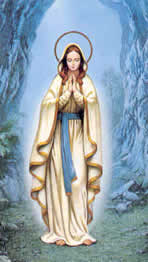
On the feast of Our Lady of Lourdes (Feb. 11), the daily Gospel happen to be the Feeding of the Five Thousand (Mark 8:1-10). A gospel passage like this makes us reflect on the reality of hunger in the world. Maybe we ourselves do not experience hunger, but certainly someone in our neighborhood is hungry this very moment. In Africa, a child or perhaps hundreds of children are dying because of hunger. The recent Ultra stampede which killed 74 people is just another instance of how hunger has become a life-and-death situation in this country.

How can a feast like this spur us to address this urgent problem? How can devotion to the the Blessed Mother move us from pious rites and rituals to a real concern and concrete action for our hungry brothers and sisters? Perhaps we can ask how Mary has become blessed by all generations and among all women. What has she done for the millions of hungry children and people all over the world?

I don't know if the answer: "She has brought Jesus to the world" will convince you. But isn't it true that if, like Mary, we bring Jesus to our hungry brothers and sisters, we can not but give them something to eat, or teach them to find something to eat. Because when Jesus Himself saw the crowds who were exhausted and hungry, He had compassion for them and He did something to feed them.

What to do in the face of hunger in the world? As Mary did, bring Jesus to the world that is hungry, yes for physical food, but more so, for spiritual food, Jesus Himself.

Saturday, February 04, 2006

Jesus, the Healer, A Man of Prayer


Where does Jesus' healing power come from? Today's Gospel seems to highlight Jesus' healing activity: he healed Simon's mother-in-law who was suffering from a fever; he cast out demons from those possessed by them; he cured all other sickness in people brought to him. Jesus seems to be a wonder worker, a miracle worker, with supernatural, spectacular powers. But where does his healing power come from? From himself, from his own authority? The answer lies in one seemingly insignificant detail in the Gospel: that of Jesus taking time to pray very early in the morning.

This is where Jesus' healing power comes from: from his prayer. He is able to heal because he is a man of prayer. His communion with the Father is the source of his power. Were he not receiving strength from His Father, He could not heal. Were he not strengthened by the love of His Father, he could not have absorbed all the "negative energies" from all the sick and possessed people brought to him. Jesus is the healer because He is a man of prayer.

In various ways, we are called to be healers, whether as physicians or as ordinary people: to heal broken bodies, broken hearts, broken psyches, broken relationships. But where shall we get the power and the strength if not from prayer? May we make prayer an essential and non-negotiable element in our daily life.

Blessed be the Lord who heals the broken-hearted!